Research
Software developments
The BIPV Lifecycle Cost Calculator (LCC) co-developed with Bieri Monika that enables to evaluate the payback time and other benefits from adding BIPV to a building façade and helps building professional to consider BIPV at an early design stage. The BIPV LCC is freely available on the National Solar Repository (NSR) website (http://www.solar-repository.sg/lcc-calculator)
The BIPV web site www.bipv.sg – developed and integrated the sharing platform with the knowledge regarding BIPV/BAPV, latest technologies, BIPV projects worldwide, latest BIPV publications and events.
Projects – Lead PI
2016-2018. Project Investigator and manager for Ministry of National Development – Sino-Singapore Tianjin Eco-City Administrative Committee Green Building – related R&D grant (200K SGD) entitled “Holistic life cycle cost analysis and real-world test- bedding for Building Integrated Photovoltaics (BIPV) facades”. Project aimed to identify main challenges, technical, economic, and aesthetic aspects foracceleration and deployment of BIPV in different climate zones and countries (China and Singapore).
2015-ongoing. Industry projects execution and reporting on testing of façade elements and fenestration systems with Calorimeter Laboratory equipment (Hot-Box, Large Integrated Sphere, UV-VIS-NIR spectrophotometer). Execute high precision modeling with tested data to assess thermal properties of the materials, assess the solar potential analysis of the buildings, urban areas and quantify the energy yield and potential installed capacity of the PV modules. (Over 100K SGD).
Projects – Co-PI and Collaborator
2017-ongoing. Co-Lead of SERIS’ Flagship Project on “Building-Integrated PV” (~0.6 M SGD/an) to develop innovation around BIPV and address relevant industry barriers for accelerated adoption of BIPV in Singapore and beyond.
2018-ongoing. Technical lead for main contractor and for BCA GBIC DEMO Grant (~4M SGD) for adoption of colored BIPV façade at PSA Admin Building, PSA Tuas Mega Port, to be deployed in 2020.
2018-2020. Technical Lead for “Building Integrated PV” for “Update of the Solar Photovoltaics (PV) Roadmap for Singapore” funded by Prime Minister’s Office of Singapore – Strategy Group, under tender PMOSTGETT18300005, total amount S$498K. Holistic assessment of all facades in Singapore island-wide for adoption of BIPV/BAPV.
2017-ongoing. Project Collaborator for grant National University of Singapore (NUS) – City Development Land (CDL) Tropical Technology Laboratory (T2 Lab) research grant (2.1 million SGD) entitled “Evaluation and Development of Energy Efficient PV Systems in Tropical Environment” to develop optimal design of the building envelopes with proposed photovoltaic technologies. The T2 Lab autonomously set up in Kent Vale at NUS campus to investigate the impact of the real-life tropical urban environment on the performance of innovative BIPV systems.
2017. Contributor to EIRP-13: Reducing cost and increasing yield through optimization in urban morphology and its design guidelines (Holistic LCOE reduction for distributed solar PV systems in Singapore) in collaboration with NUS Department of Buildings, EDF (Asian Sustainable Cities Center of Excellence in Singapore), TUM Create
SERIS Building Integrated PV Flagship Project
Co-Lead of SERIS’ Flagship Project on “Building-Integrated PV” (~0.6 M SGD/a) to develop innovation around BIPV and address relevant industry barriers for accelerated adoption of BIPV in Singapore and beyond.
Holistic life cycle cost analysis and real-world test- bedding for Building Integrated Photovoltaics (BIPV) facades

Project Investigator (PI) for Ministry of National Development – Sino-Singapore Tianjin Eco-City Administrative Committee Green Building – related R&D grant (200K SGD) entitled “Holistic life cycle cost analysis and real-world test- bedding for Building Integrated Photovoltaics (BIPV) facades”. Project aimed to identify main challenges, technical, economic, and aesthetic aspects foracceleration and deployment of BIPV in different climate zones and countries (China and Singapore).
Dr Shabunko conducted an experimental real-world test-bedding of several BIPV technologies as double-skin façade in front of the existing windows of a conference room at the School of Design and Environment (SDE) on the National University of Singapore (NUS) campus. Three different BIPV technologies – semi-transparent PV modules with monocrystalline silicon cells, coloured PV modules with mono-crystalline silicon cells, and opaque PV modules with multi-crystalline silicon cells – are installed and measured in real-world outdoor conditions with high-precision equipment. In addition, thermal measurements of the exterior as well as the indoor space behind the BIPV façade are carried out. The results are also relevant in a wider context, i.e. how BIPV facades can contribute to the deployment of positive low-rise, zero-energy medium rise and super-low energy high-rise buildings in Singapore
Click here to watch video of BIPV facade
Life Cycle Cost Calculator for Building Integrated Photovoltaics (BIPV)
Dr. Shabunko with Monika Bieri have developed the BIPV Life Cycle Cost Calculator (LCC), and integrated on the National Solar Repository (NSR) website based on the results from the technical assessment of the first BIPV test-bed.
This online toolkit is suitable for architects, developers and building owners and provides a comprehensive life cycle cost analysis of BIPV addition (for various orientations) to assess the economic feasibility of BIPV facades at an early design stage. This includes the total capital investment and a detailed breakdown of the benefits of BIPV integration, i.e. energy savings, carbon emissions avoidance and payback time.
The online BIPV LCC toolkit for tropical environments (see video below) is available online at http://www.solar-repository.sg/lcc-calculator/
Author: V. Shabunko, 2018, Video: V. Shabunko 2018
Watch video tutorial here:
Assessment of vertical surfaces in Singapore: Update of the Solar Photovoltaic (PV) Roadmap for Singapore
As a part of the “Update of the Solar Photovoltaic (PV) Roadmap for Singapore” SERIS Singaporetogether with the BIPV Centre of Excellence in close collaboration with Patrick Janssen from Department of Architecture at NUS carried out holistic assessment of island-wide vertical and horizontal spaces in Singapore suitable for deployment of BIPV/BAPV technologies. The 3D model of Singapore in form of CityGML LoD2 was provided by Singapore Land Authority Survey & Geomatics team (thanks to Zhen Hao Ng ) led to successful solar potential assessment of all vertical surfaces island wide. Congratulations to Congyi Tan, Dr Zhang Ji, Dr Veronika Shabunko, Jack Lee Han Jie, Prof Patrick Janssen for such excellent results and valuable collaborations.
Technical Lead for “Building Integrated PV” for “Update to Solar Photovoltaics (PV) Roadmap Study” funded byPrime Minister’s Office of Singapore –Strategy Group, under tender PMOSTGETT18300005, total amount S$498K. Holistic assessment of all facades in Singapore island-wide for adoption of BIPV/BAPV. (2018-2020)
Author: V. Shabunko 2020, Video: SERIS-NUS-SLA research team 2020
Watch solar potential analysis of Singapore, island-wide:
Channel News Asia: Powering the Future
To install panels on more surface areas, Singapore is also turning to building facades. This requires special panels known as building-integrated photovoltaics (BIPVs), which can be placed on buildings in many ways.
“BIPVs can be structurally integrated into balconies. They can be used as a window facade, as cladding … and as a prefabricated system that can be easily plugged into the facade,” said Seris research fellow Veronika Shabunko.
Source: CNA
Watch full documentary here:
“Living Catalogue” for Building Integrated PV in the tropics
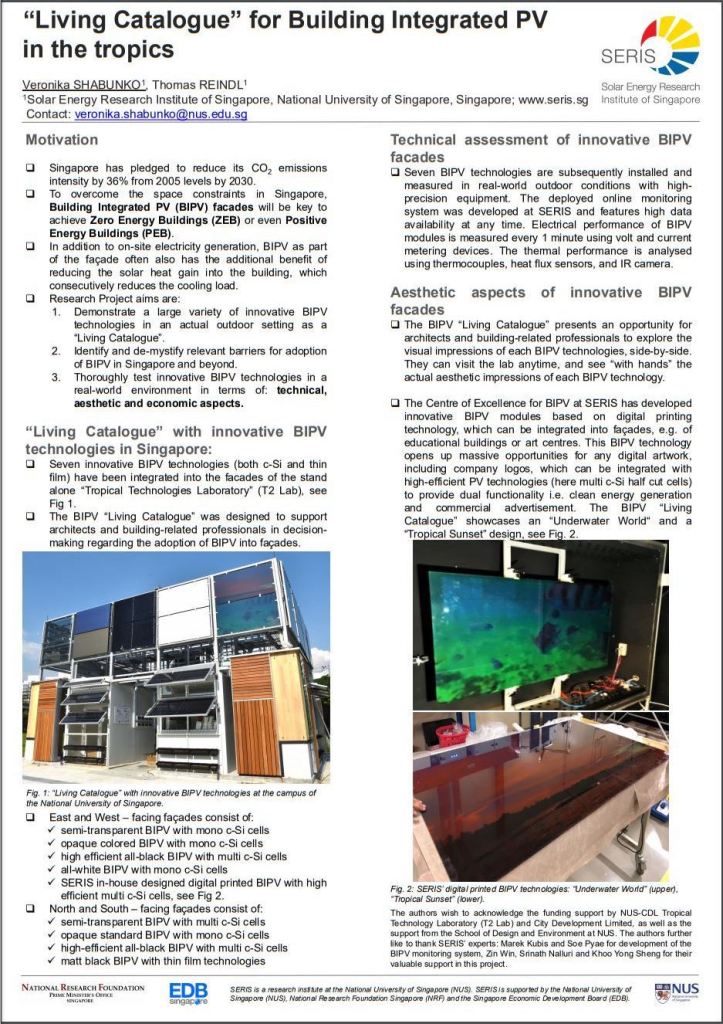
The BIPV COE designed the BIPV “Living Catalogue” on the NUS campus, showing and testing some of the latest BIPV technologies (see photo below), to address various technical, aesthetic and economic aspects of BIPV. It is part of the “T2 Lab”, implemented together with NUS’ School of Design and Environment and funded by CDL.
Project Manager for grant National University of Singapore (NUS) – City Development Land (CDL) Tropical Technology Laboratory (T2 Lab) research grant (2.1 million SGD) entitled “Evaluation and Development of Energy Efficient PV Systems in Tropical Environment” to develop optimal design of the building envelopes with proposed photovoltaic technologies. The T2 Lab autonomously set up in Kent Vale at NUS campus to investigate the impact of the real-life tropical urban environment on the performance of innovative BIPV systems.
Consultancy for coloured BIPV facades at the new PSA Super Low Energy Building at the PSA Tuas Mega Port
The BIPV COE carried out technical consultancy for the main contractor and the PSA Corporation Limited for the proposed coloured BIPV facades at the new PSA Admin Building, which aims to achieve the targets set out in the latest BCA “Super Low Energy Buildings” (SLEB) Green Mark scheme. The project has been awarded a demonstration grant from the BCA GBIC (Green Buildings Innovation Cluster). A detailed technical, economic and aesthetic assessment was carried out to identify over 2000 square metres of areas suitable for BIPV/BAPV deployment on the West- and North-facing facades, for a total installed capacity of ~300 kW, see image below.
Technical lead for main contractor and for BCA GBIC DEMO Grant (~4M SGD) for adoption of colored BIPV façade at PSA Admin Building, PSA Tuas Mega Port, to be deployed in 2020. (2017-2020)
Solar EIRP-13
Reducing cost and increasing yield through optimization in urban morphology and its design guidelines (Holistic LCOE reduction for distributed solar PV systems in Singapore) in collaboration with NUS Department of Buildings, EDF (Asian Sustainable Cities Center of Excellence in Singapore), TUM Create (2016-2017)
 veronikashabunko.com